
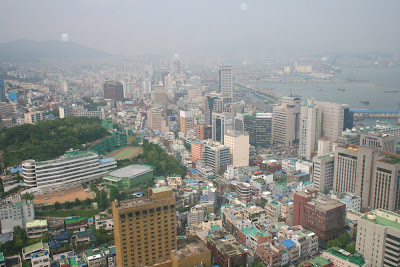
 While the South Korean landscape is quite similar to Japan’s, Korea seemed to have more open space, and far more tall buildings. Of course Japan has skyscrapers, and blocky, minimalist apartment complexes sprawl out from its major cities for kilometers. Still, one of the things that surprised me most when I arrived in Japan was that it’s really not that built up (because of earthquakes?)—even Shizuoka’s tallest structures top out at just over 20 stories. But in Korea, apartment buildings easily clearing 20-30 stories stood in squared-off clumps in seemingly the middle of nowhere. I suppose the country (which is more dense than Japan) keeps its green space when residents are crammed into skyscrapers (and I’m not saying this is a bad idea).
And to conclude my ill-informed compare/contrast session: Busan actually was a lot like San Francisco! I’d read that the cities were strikingly similar in climate, topography, and “cosmopolitan atmosphere”—and Busan indeed had a sparking bay spanned by bridges, fishing boats and fish markets, and an upscale shopping district with all the typical brands.
I had to walk a few blocks to transfer between train lines...


 Then I walked into the train station to hear Nancy Sinatra’s “Sugartown” playing on the soundsystem. After my second train ride, I stepped out of Busan Station and…now that’s weird:
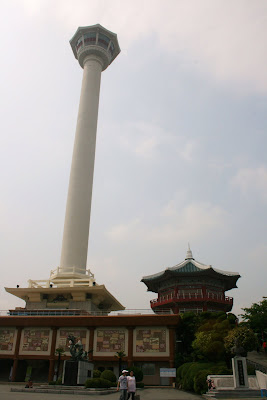
 On my way to Busan Tower:
 Exploring the water's edge:


 The fish market was bordered by a dried fish market...and further on, a strip of herb shops.
 After a full day of wandering, I took an evening express train all the way up to Seoul.


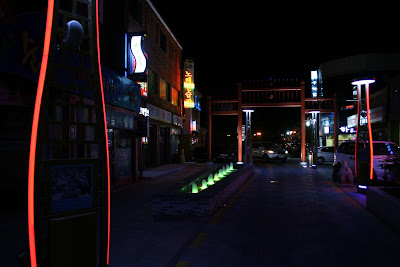 I wandered through the quiet town to find Sa Rang Chae, a traditional Korean house divided into guest rooms. This was mine:

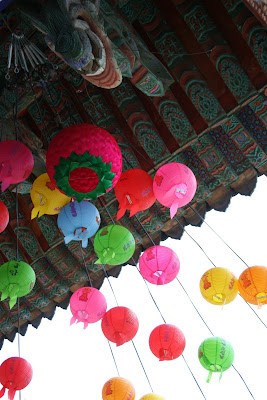
 Despite the dreariness, I took a bus southwest of town to Gyeongju National Park, where I visited Bulguk-sa and Seokguram in the forested hills. Bulguk-sa is a temple complex on the side of Toham-san mountain. A temple was first constructed here in 550; the complex grew to include 80 buildings, but after feuds in the 1500’s and the Korean War, only about 8 reconstructed buildings stand today. Nevertheless, Bulguk-sa is the most visited temple in Korea and the brightly-detailed wooden structures are really something to see.

 Buddha's birthday was a few days before my visit, so I'm not sure if the lanterns were displayed for the holiday, or if they're always up.




 The drizzle had become a downpour by the time I reached the exit gate, so I ducked into a tiny shop for bibimbap (hotpot of rice and vegetables with egg scrambled in), spicy tofu soup, and the requisite assortment of kimchi/pickles.


 Along with a few other tourists, I sloshed along the winding, lantern-lined trail for a look at the carved-out cave housing the pale stone Buddha, currently protected by glass inside this wooden building:
 Back in town, the sun made a brief appearance, so with a change of shoes and socks, I visited Cheomseongdae, which is possibly the oldest astronomical observatory in Asia! While it just looks like a giant stone bottle, this 9-meter tower was built around 640 using specific calculations based on star positions.


 In the late afternoon, I wandered around 20-some Silla Dynasty burial mounds in Tumulus Park. The park also houses a museum which displays a cross-section of a mound: the coffin is placed on the ground, a small wooden structure is built over it, then the structure is piled with rocks, the tallest mound in the park reaching 23 meters high.


 After hanging out in the guesthouse's common area post-dinnertime with a couple German guys and a family from France, the next morning I was off to Busan, Korea's principal port!