I considered taking a ferry, but there are quick, cheap direct flights twice daily from Shizuoka to Seoul (and we all know poor weather can make the most scenic ferry ride vomtastic). Since Seoul is a popular travel destination for many foreigners here in Japan, I’d got a heads-up on the Pizza Hut located at Seoul Station. Since I hadn’t actually eaten at Pizza Hut in ages, I can’t say I was feeling deprived in any way…it’s just, there was something about it being uber-American and available that beckoned me in for a personal-pan cheese and giant Mountain Dew. Don’t scoff at me, Internet; I ate Korean food the rest of my trip.
I picked up my dirt-cheap 3-day all-you-can-ride rail pass and hopped a train to Gyeongju, a city in the southeastern corner of the peninsula that was capital of the ancient Silla Kingdom; I read that Gyeongju is to Korea what Kyoto is to Japan. All aboard.


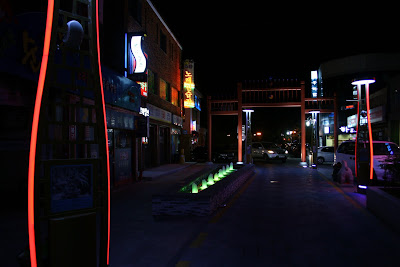 I wandered through the quiet town to find Sa Rang Chae, a traditional Korean house divided into guest rooms. This was mine:


 Despite the dreariness, I took a bus southwest of town to Gyeongju National Park, where I visited Bulguk-sa and Seokguram in the forested hills. Bulguk-sa is a temple complex on the side of Toham-san mountain. A temple was first constructed here in 550; the complex grew to include 80 buildings, but after feuds in the 1500’s and the Korean War, only about 8 reconstructed buildings stand today. Nevertheless, Bulguk-sa is the most visited temple in Korea and the brightly-detailed wooden structures are really something to see.


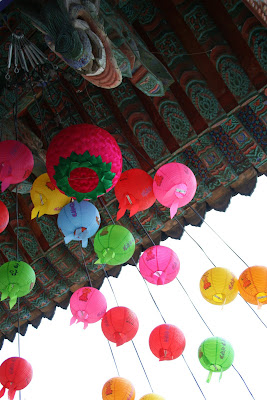
 Buddha's birthday was a few days before my visit, so I'm not sure if the lanterns were displayed for the holiday, or if they're always up.




 The drizzle had become a downpour by the time I reached the exit gate, so I ducked into a tiny shop for bibimbap (hotpot of rice and vegetables with egg scrambled in), spicy tofu soup, and the requisite assortment of kimchi/pickles.
 Seokguram, or "Stone Cave Hermitage," is a grotto carved out of the side of the mountain, an hour's hike above Bulguk-sa.


 Along with a few other tourists, I sloshed along the winding, lantern-lined trail for a look at the carved-out cave housing the pale stone Buddha, currently protected by glass inside this wooden building:

 Back in town, the sun made a brief appearance, so with a change of shoes and socks, I visited Cheomseongdae, which is possibly the oldest astronomical observatory in Asia! While it just looks like a giant stone bottle, this 9-meter tower was built around 640 using specific calculations based on star positions.


 In the late afternoon, I wandered around 20-some Silla Dynasty burial mounds in Tumulus Park. The park also houses a museum which displays a cross-section of a mound: the coffin is placed on the ground, a small wooden structure is built over it, then the structure is piled with rocks, the tallest mound in the park reaching 23 meters high.
 Kings and queens were buried in joined mounds such as this:


 After hanging out in the guesthouse's common area post-dinnertime with a couple German guys and a family from France, the next morning I was off to Busan, Korea's principal port!


 At this arena, "box" seats = four pillows in a barred-off box. Not what I'd imagined. Way better than our actual seats...
 ...which were up here:
 Regardless of where I was seated, the whole experience was unforgettable. The second-tier guys walked in and formed a circle up on the dohyo (sumo ring/platform), performed a series of ceremonial movements, then filed out; this signaled the start of the intermediate matches.


 After all the intermediate matches, the super-famous top-tier wrestlers came in and performed the same ritual before their bouts commenced.


 There aren't weight limits in sumo as there are in wrestling or boxing, so throughout the day we got to see some (relatively) little guys go up against really huge dudes. And even up in the cheap seats, some spectators got pretty fired up cheering for their favorites. The wrestlers would face each other in the ring and do this whole psych-out bit first, then return to their respective corners to wipe their faces and toss more salt out into the ring. They'd return to face off and complete a few distinct movements, then with all anticipation mounted, the wrestling would start...and sometimes end seconds later. It was pretty awesome when a pair would deadlock and we had time to cheer before one took the other down. The sandy surface was groomed between matches, and quite meticulously before a pause between bouts for a ceremonial dance:

 Then the day's matches were all finished, seemingly quickly. And my camera was dead. I hope to post a few more photos of the matches if I can snag some from a friend's camera...the more close-up sumo butts the better, right?


 Some great info on what to expect from our cave experience:


 Saturday was the epic day of obsessively observing Fuji from every possible vantage point, framed by every beautiful flower or tree. Leaving the pension and hiking toward the Kawaguchi lakeshore:


 Along the north side of Kawaguchi-ko, gorgeous weather bringing out anglers and waterskiers galore:


 Then, out onto the lake in the most cheerful vessel! I have since looked into


 Our last stop was Fujiyoshida, to visit the radar dome that was first stationed on Fuji's peak in 1936, where it collected life-saving meteorological data for decades (It now looks back at its former home in the distance). We had a spicy hotpot, with a lump of tofu resembling the radar dome, across the street at the Fujiyoshida bierhall, then made a wide curve around the mountain by train to our home on the southwest side.

