 Ahoy, matey.
Thursday, April 29 was a national holiday, so Brian, Davin, Jaime, and I took off for Fuji-Hakone-Izu National Park, where the main attraction is transportation. With the purchase of the Hakone Free Pass, visitors can enjoy unlimited use of four different modes, in fact—boat, alpine railway, funicular, and cable car—which together make a complete loop around the area, offering views of clear lakes, forests, sulphurous hot springs, and snowcapped Mt. Fuji if the weather cooperates.
 Not even windy, rainy weather could dampen our pirate ship fun on Lake Ashinoko; we had run of the deck since the other passengers were all huddled inside. Fire the cannons!


 Land ho! In the village of Hakone, a reconstructed checkpoint of the Old Tokaido Road, the historic coastal route from Tokyo to Kyoto.

 Recovering from the incident five minutes prior when a fisherman cast into the wind and hooked Brian's pants, wrapping him with line:
 Then on to Japan's oldest alpine railway! It switchbacked slowly up one side of a huge hill by moving back and forth on graded tracks.
 All that pirate ship excitement took a lot out of my groupies.

 But next came the FUNicular. This elevated railway took us from the alpine train station higher up in the hills to connect with the cable car system.

 The Hakone Ropeway holds the Guinness Book record for "World's Busiest Gondola Lift"! The day we visited, it had been shut down all morning due to rain and high winds, but the late afternoon sun showed up and the weather calmed just enough for the ropeway to open for a couple hours.
 It was still quite gusty, causing our gondola to sway as we passed over a valley dotted with wisps of steam venting from sulphur hot springs.
 We reached the crest of the hill, and there was Fuji, gorgeous in the glaring sun. The eight or so of us in the gondola gave a collective gasp :)
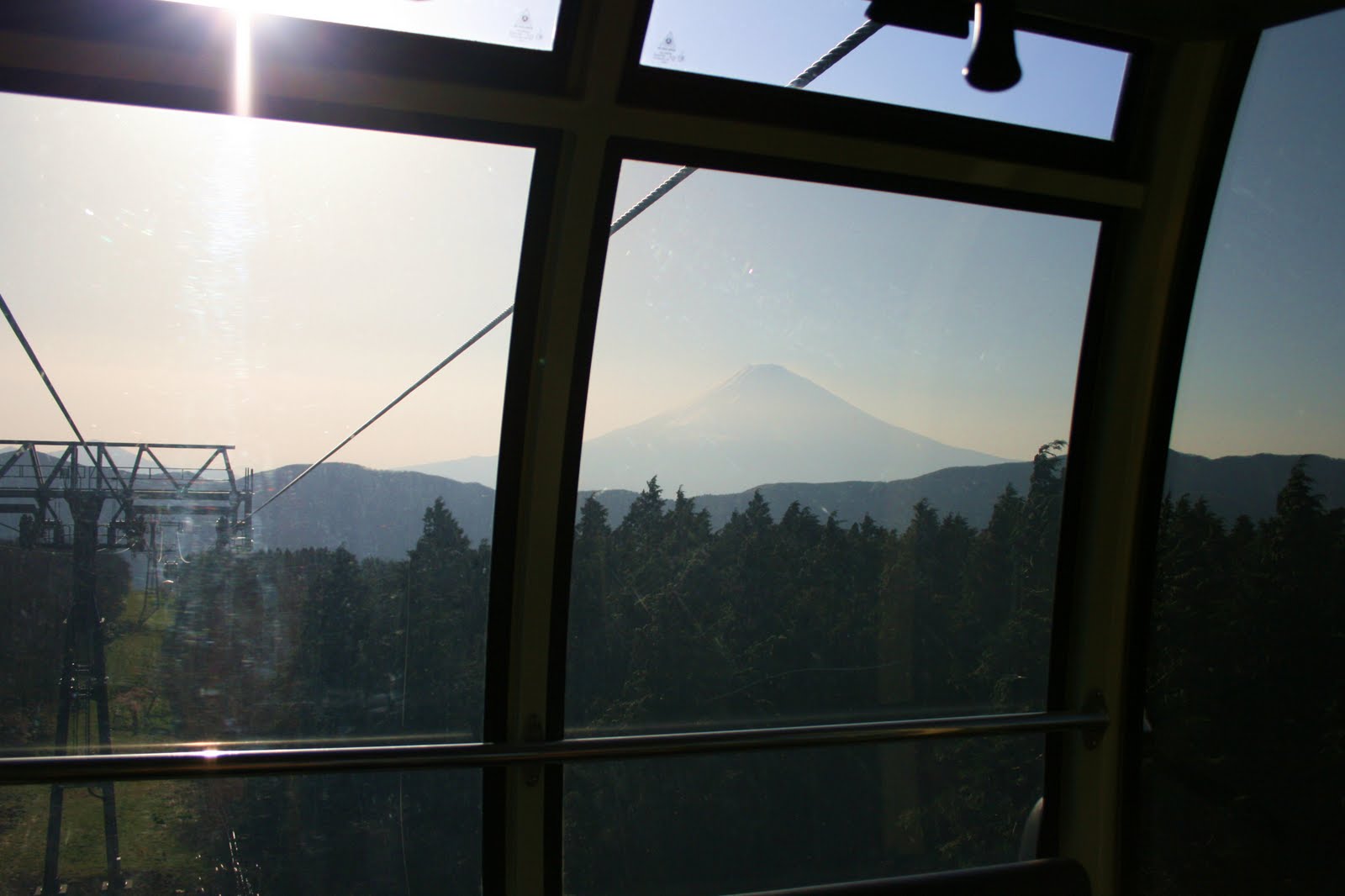
 Then the ropeway descended to the lakeshore where we'd boarded the ship that morning, the loop complete.
 And in the ropeway ticketing area, we found the perfect destination for our next mini-vacation:
 A spa near Hakone with a variety of themed bathing pools—including red wine, green tea, sake, coffee, and more—each bath with specific health-enriching qualities (so they advertise). Oh, Japan!


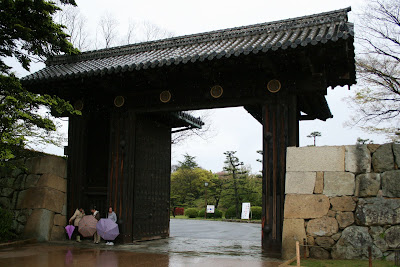
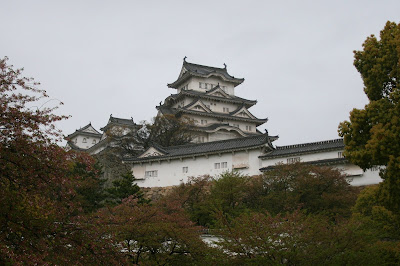
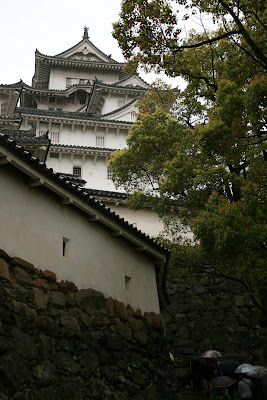
 Lots of winding, strategically-designed paths to slow any advance toward the main building...

 And heron-themed sewer covers, naturally!


 But the cherry blossoms were out around the lakeside town, which had some small, peaceful temples...

 Although the school was a bit rougher. Two eighth-grade boys came to class with bleached-orange hair and rows of silver earrings up their lobes; one was wearing an oversized electric-pink hoodie that marshmallowed out from the neck and armholes of his black uniform jacket. In my last district, the moment these kids set foot on school grounds, they would have been hauled off by the Vice Principal (with several other teachers along for backup) to be stripped of jewelry and bright clothes, and thoroughly scolded whilst having their hair coated with black shoe polish. For real.


 Never have I seen trees so old and tired, just wanting to return to the earth, yet propped up with so many crutches:


 Next, on to the Osaka Human Rights Museum, not quite so fun but actually really interesting. Exhibits explained the state of human rights in Japan today, then gave a bunch of information about groups historically (and even currently, in some cases) discriminated against, such as Koreans in Japan (many of whom came to Japan when Korea was under Japanese rule, and particularly women who were used as "comfort women" for powerful Japanese men), Okinawans (who, when they move to the mainland, have at times been excluded from communities), the Ainu people of northern Hokkaido (indigenous people who struggle to keep their culture alive), sexual minorities, people with disabilities and disease, and the Buraku (a social minority stemming from the caste system, which was dissolved in 1871, though these people are still sometimes limited in the type of occupation they can pursue).


 Sunday morning, I took a loop around Byodo-in, the southern Osaka "phoenix temple" featured on the 10-yen coin.


 Then another train ride took me southeast to Nara, the capital of Japan from 710 to 784 (yes, Nara was celebrating its 1300th anniversary), packed with temples and shrines within primeval forest, the whole place considered a UNESCO World Heritage Site. Kofuku-ji is a Buddhist temple complex that was established here in 710; the octagonal hall, Nanendo, and the five-storied pagoda, Goju-no-to, are the first main sights to greet visitors to Nara Park.

 Then a wide walkway lined with souvenir shops and food stands leads through huge wooden gates toward the largest wooden building in the world!

 Todai-ji, constructed in 752, has been destroyed twice over the years, rebuilt both times on a smaller scale. Inside the building is a display showing the dimensions of the original structure, and it's incredible. The original was far wider and taller, and on each side of the main building stood a pagoda twice as tall as the present five-storied pagoda in Kofuku-ji.


 Todai-ji houses the largest enclosed Buddha statue in Japan (the one on the right), which in 752, took half of the bronze in all of Japan to create, putting the country into great debt.

 Yet another declared National Treasure in Nara Park is the population of tame deer. The whole town is filthy with deer, some lazing about waiting for tourists to feed them rice crackers, some hungrier once going after whatever's in tourists' hands or pockets. There's a festival each spring to de-horn them.


 Well, the animals aren't entirely tame, or harmless without horns; I saw at least a couple kids get pushed over and frightened by a hungry or annoyed deer. I'm not sure anyone was paying attention to the Bite/Kick/Butt/Knock down warning signs.

 Nara is a sister city to Gyeong-ju, the cultural capital of South Korea, which I just visited a few days ago! I'm once again quite behind on posting photos. Up soon: the largest castle in Japan, a sumo tournament, and my trip to South Korea.


